On 30 October, IT Dong-A ran a profile of CEPiEL as part of its series on the Start-up NEST 19 cohort — the scale-up programme run by the Korea Credit Guarantee Fund (KODIT) with The Invention Lab as accelerator. The original article is in Korean; this is not a translation, but my own short summary of what we talked about, for readers outside Korea.
The problem: data is not the bottleneck any more
Most chemical plants already have thousands of sensors. Collecting data is the easy part. The hard part is turning that data into a change in how the plant is actually run — and doing it in a way the people responsible for the plant will trust.
When I moved into academia after 13 years in industry (GS E&C, AspenTech, UOP), the same frustration followed me. Plant software is still mostly imported, and it is fragmented: process simulation, data management, predictive maintenance, and advanced process control each sit in their own tool, under their own licence, and rarely talk to each other. As I put it in the interview:
"Every time you want to add a capability, you buy another licence — and the pieces still don't connect." (translated from Korean)
CEPiEL started from a simpler observation: the data-reconciliation and AI-based optimisation methods we developed at CEPI Lab were already delivering results in real plants. The goal is to bring them together on one platform, at a cost a mid-sized manufacturer can justify.
What we're building
Two products, one pipeline:
- CEPiDTS™ — the digital-twin platform. Sensor data is cleaned and reconciled, checked against a first-principles process model in near real time, and then used to train ML models that recommend operating conditions.
- CEPiML™ — the AI training and optimisation engine underneath. It auto-selects and tunes from 16+ ML algorithms, including physics-informed neural networks (PINNs) that put the governing equations directly into training.
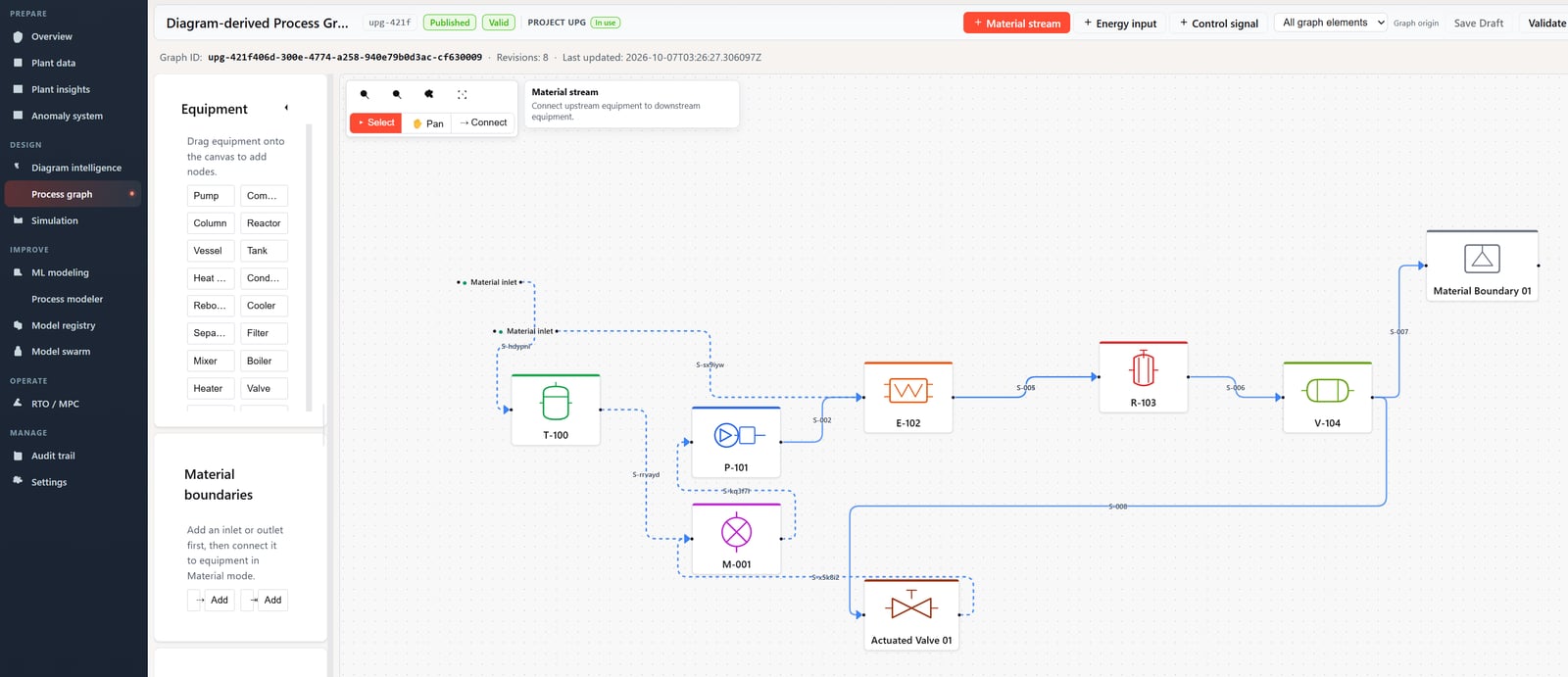
A few design choices are worth calling out.
Soft sensors built from CFD. Some of the most important variables in a plant — temperature profiles inside a reactor, compositions you can't sample — are expensive or impossible to measure. By training on CFD results, we can estimate them at close to real-time speed, instead of waiting days for a full CFD run. We keep the nonlinear first-principles model and learn alongside it, rather than replacing it.
Open simulators, no lock-in. Commercial simulators are excellent and also expensive, which is why many mid-sized companies never start a digital-twin project at all. CEPiDTS can run open-source simulators such as DWSIM and OpenFOAM, and it connects to the commercial simulators a customer already owns. You keep the models you have and adopt in stages.
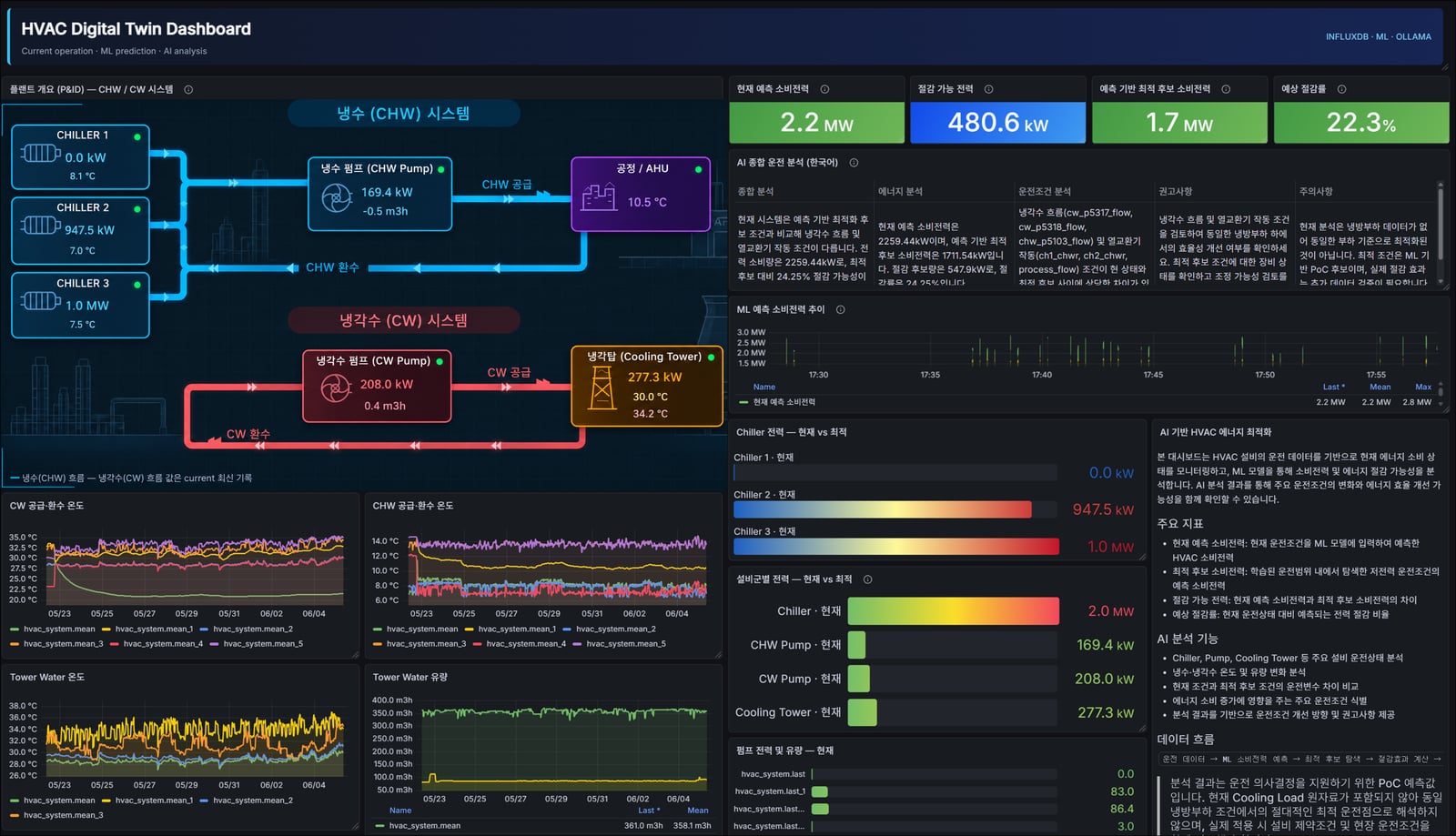
An AI that explains, not one that drives. Operators can ask questions in plain language, and the agent answers with analysis, plots, and — most importantly — why a given operating point is optimal. Because the reasoning sits on a physical model, an engineer can verify it. That matters even more in regulated industries like pharmaceuticals and semiconductors.
"The plant should find its optimum — but an engineer must be able to verify the reasoning." (translated from Korean)
A plant that stops for even a short time loses a lot of money. So we are deliberately not building a system that takes over the controls. We are building one that helps the people in the control room make a better decision, and leaves that decision with them.
Starting with utilities
Our first target is the part of the plant every industry shares: the utility system — steam, cooling water, chillers. Utilities are a large share of a site's energy use, have many interacting variables, and are still largely run on operator experience. That makes them the right place to prove value before moving into core production units.
Since CEPiML launched in April, the work has picked up: a digital-twin project for an FPSO topside process as part of a consortium with a global process software company, an anomaly-detection project on an EDC cracker for a Korean chemical company, discussions on a utility digital twin with a petrochemical producer, and an HVAC energy-optimisation project in Singapore. On an LNG liquefaction pilot with a Korean shipbuilder, a CEPiDTS proof of concept cut energy use by roughly 5–6%.
What's next
Next is CEPiML 2.0: a chemical-process ontology — a machine-readable map of how equipment, variables, and operating documents relate — combined with an LLM interface, so an engineer can talk to the whole plant in natural language. Alongside that, with our co-CEO Paul Cho and the KhaiEL team, we are working on Singapore as a first hub abroad and on the North American market.
"I want to show that a process-AI company born in Korea can work alongside global commercial software and still give customers a more reasonable choice." (translated from Korean)
Thanks to KODIT and The Invention Lab for the Start-up NEST programme, and to the IT Dong-A team for the conversation.
Source: Kim Ye-ji, "CEPiEL: combining physical laws and AI to help plants find their optimal conditions — digital-twin innovation on the factory floor [Start-up NEST 19]", IT Dong-A, 30 October 2026 (in Korean). Read the original article → Also published on donga.com.